
2nd International Competition on
AI in Education 2026
Background
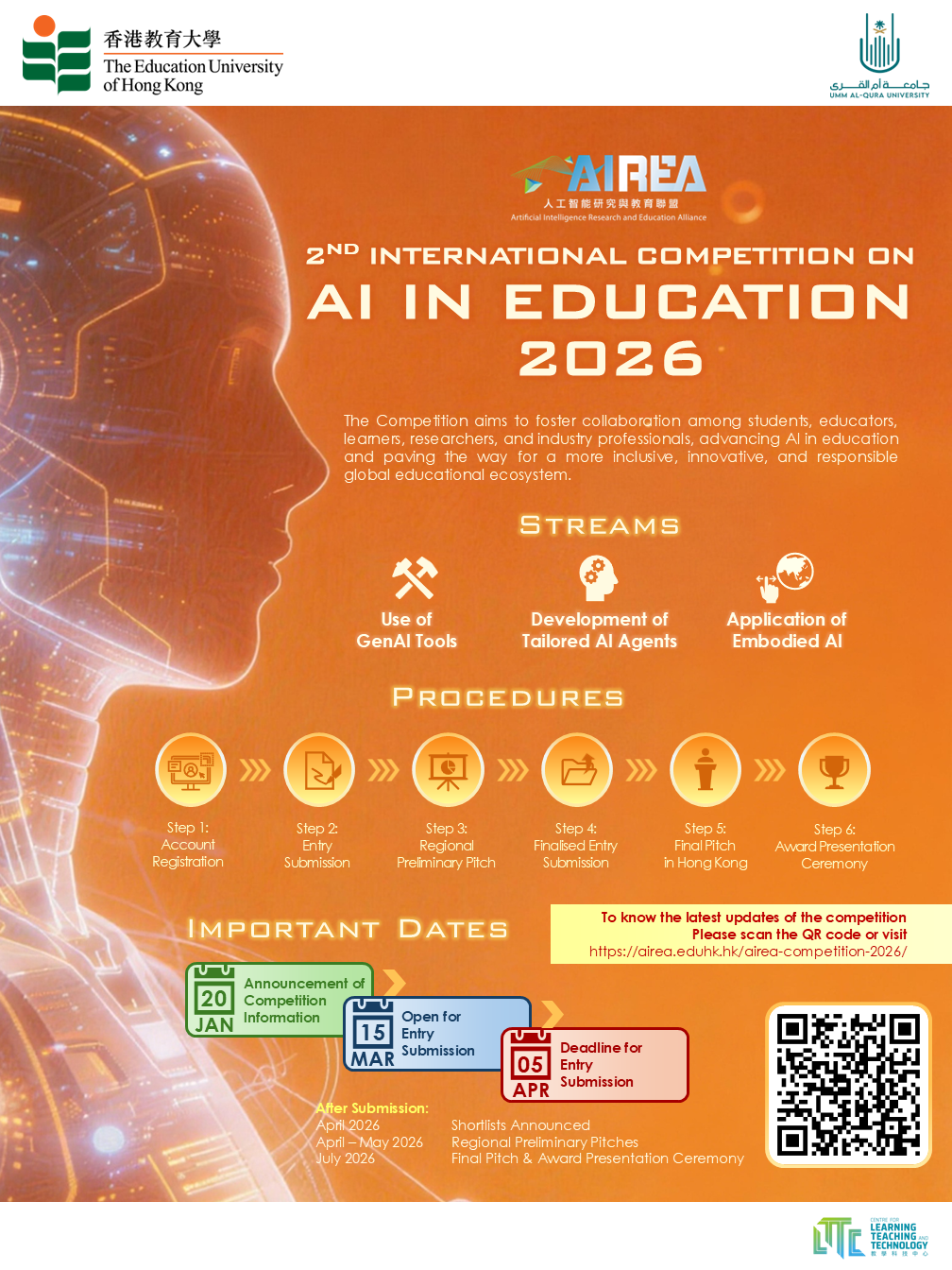
The Artificial Intelligence Research and Education Alliance (AIREA) of The Education University of Hong Kong (EdUHK) will host and present the 2nd International Competition on Artificial Intelligence in Education 2026 (“The Competition”), designed to revolutionise the integration of artificial intelligence (AI) in education. The Competition fosters collaboration among students, educators, learners, researchers, and industry professionals, advancing AI in education and paving the way for a more inclusive, innovative, and responsible global educational ecosystem.
Streams
All streams are open to both individuals and teams. Each team can have up to 4 teammates. The competition will also feature different categories based on participant affiliations.
Use of GenAl Tools
The Stream 1 “Use of GenAI Tools” focuses on the practical and ethical integration of generative AI into existing educational ecosystems. We invite projects that develop innovative frameworks, curricula, and teaching methods that leverage AI to improve learning outcomes. Submissions should demonstrate how to apply AI tools within learning platforms and pedagogical strategies to create more engaging, efficient, and equitable educational experiences.
Development of Tailored Al Agents
The Stream 2 “Development of Tailored AI Agents” expects participants to design and build novel AI applications that serve as personalised, proactive learning companions for recognised learning scenarios and needs. The focus is on creating “agentic” systems that autonomously guide students and “tailored” tools that adapt deeply to individual needs. Key areas include developing AI-powered tutors, dynamic assessment tools that provide instant feedback, and systems that deliver actionable insights to both educators and learners while upholding academic integrity.
Application of Embodied Al
The Stream 3 “Application of Embodied AI” explores the future of education beyond the screen by integrating AI with the physical world. We seek projects that use embodied AI, robotics, and spatial computing (AR/VR) to create immersive, hands-on learning designs and experiences. The goal is to develop intelligent systems that interact with students in real-world scenarios, transforming physical spaces into dynamic, responsive learning environments.
Entry Submission
(Entry submission link will open on 15 March 2026.)
Topics
(1) Personalised and Adaptive Learning with Generative AI:
Developing generative AI-assisted tools for personalised learning and adaptive feedback.
(2) Generative AI-enhanced Learning Analytics:
Developing generative AI-powered tools to enhance learning analytics and deliver actionable insights for educators and administrators.
(3) Using Generative AI Tools to Support Special Educational Needs:
Designing generative AI-powered tools to assist students with special educational needs.
(4) Engagement and Motivation Analysis in Generative AI-assisted Learning:
Developing generative AI applications to analyse and enhance student motivation and engagement in learning activities.
(5) Generative AI-empowered Collaborative Learning:
Developing generative AI-based tools and platforms that facilitate and enhance collaborative learning. These tools should leverage generative AI to foster meaningful interactions, encourage knowledge sharing, and promote teamwork.
(6) Effective Integration of Generative AI Tools in Pedagogies:
Developing frameworks, models, and standards for integrating generative AI tools into existing learning tools, teaching methods, curricula, and online learning platforms.
(7) Reliable and Relevant Generative AI Application in Education:
Developing methods and solutions to deploy generative AI in teaching and learning scenarios, and to improve the quality, accuracy, reliability and relevance of Generative AI Tools.
(8) Innovating Assessments in the Era of Generative AI:
Designing new assessment techniques and tools that leverage generative AI and AI literacy while maintaining academic integrity.
(9) Generative AI-assisted Learning Content Design:
Developing tools and techniques to create engaging and effective learning content using generative AI.
(10) Ethical, Fairness, Privacy, Equity, Diversity, and Inclusion Aspects of Generative AI in Education:
Developing solutions to ensure the responsible and equitable use of Generative AI in educational settings.
(11) Education for Citizenship and Sustainable Development:
Designing strategies that optimise the synergy between educators, learners, and AI, fostering co-creation, adaptive support, and shared decision-making to enrich the educational experience.
(12) Spatial and Embodied Intelligence in Education:
Exploring innovative approaches and frameworks to integrate spatial and embodied intelligence into educational environments, such as the metaverse and robotics, and developing tools and pedagogies that support movement-based, multisensory, and immersive experiences, fostering deeper engagement and understanding across diverse disciplines.
Procedures
(1) Account Registration:
All interested participants are required to register an account on the AIREA website to ensure secure access to the competition portal and enable tracking of individual or team submissions.
(2) Entry Submission:
Once registered, participants must complete and submit an electronic form (e-form) available on the competition portal to comprehensively introduce the project. Participants should also upload relevant project demonstrations, such as videos, prototypes, or supporting documentation, to showcase the innovation and impact of their work.
(3) Payment Process:
Each entry submission is subject to a registration fee of HK$300, payable online via the competition portal. Entries without payment will not be processed.
(4) Selection of Shortlists:
After the submission deadline, a judging panel comprising experts in education will evaluate entries based on the criteria (please refer to the following section). The panel will review the submitted materials, assess project quality and relevance, and shortlist outstanding submissions for the next stage.
(5) Regional Preliminary Selection Pitch:
Shortlisted participants will be notified via email and through the competition portal. Shortlisted teams or individuals will be required to present their projects in a preliminary selection pitch. This may be conducted face-to-face, in a hybrid format, or online, accommodating participants’ locations and regional co-organisers’ arrangements. The judging panel will assess the presentations and announce the finalists based on delivery, innovation, and potential impact.
(6) Finalised Entry Submission:
They will then be invited to submit final artefacts or supplementary materials to ensure their projects are fully represented for the subsequent evaluation round.
(7) Final Pitch and Award Ceremony:
Finalists will receive invitations to participate in the final pitch and award presentation ceremony, held in Hong Kong. This culminating event offers finalists an opportunity to showcase their work to a broader audience, engage with peers and experts, and celebrate outstanding achievements in generative AI for education.
Judging Criteria
- Problem Identification and Relevance in Education
- Feasibility and Functionality
- Social Impact and Responsibility
- Innovation and Creativity
- Scalability and Sustainability
Important Dates
The following outlines the competition procedure, including key dates and supplementary details to guide participants through each stage of the event.
(1) Release of Event Page and Call for Entry Submission (20 January 2026):
o The official event page will be launched, providing comprehensive details about the competition, including eligibility, key dates, judging criteria, and submission guidelines.
o A call for entries will be issued, inviting individuals and teams to submit innovative generative AI projects for educational use.
o Promotional materials and announcements will be distributed via newsletters and social media to reach a broad audience and encourage participation.
o Participants can access the competition portal to review the rules, prepare the required documentation, and begin the account registration process.
(2) Open for Entry Submission (16 March 2026):
o Participants may begin submitting their entries via the official competition portal.
o All submissions must adhere to the provided guidelines and formats.
o Early entries are encouraged to allow ample time for review and possible revisions.
o Each submission will require a registration fee of HK$300.
o Participants are required to complete payment at the time of submission; otherwise, their entry will not be accepted.
(3) Deadline of Entry Submission (5 April 2026):
o All entries must be submitted by this date.
o Late submissions will not be accepted.
o Participants are advised to double-check all required documents and materials before finalising their entries.
(4) Announcement of Shortlists & Arrangement for Preliminary Pitch (20 April 2026)
o The shortlisted candidates will be notified and announced on the competition website.
o These individuals will then be invited to submit a refined final version of their entry.
o Feedback from the preliminary review may be provided to assist with improvements.
(5) Regional Preliminary Selection Pitch (April to May 2026)
o Preliminary selection pitch (face-to-face/hybrid/online) organised among different regions to nominate finalists to participate in the final pitch.
(6) Deadline of Finalised Entry Submission (25 June 2026)
o Finalists must submit their final entries by this deadline.
o Submissions should address any feedback from the initial round and demonstrate further development of their ideas or projects.
(7) Final Pitch Day and Award Presentation Ceremony (July 2026)
o Finalists will present their entries to a panel of judges during Pitch Day.
o The award presentation ceremony will follow, during which winners will be announced and prizes distributed.
Throughout the competition, participants may contact the organising committee via email (airea@eduhk.hk) for clarification or support regarding submission procedures, eligibility, and event logistics. Further updates and details will be communicated via email and posted on the official competition website.